

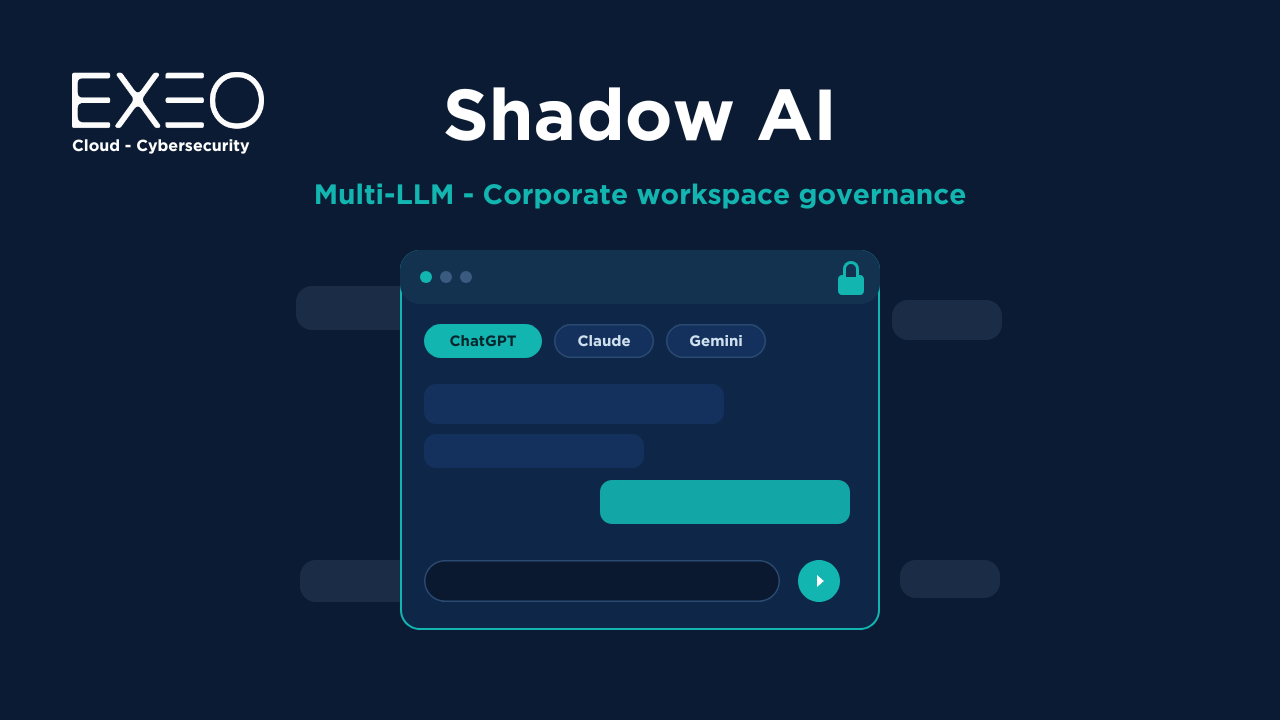
AI did not wait for a policy. Across most organisations, employees have already brought it in, pasting reports, client lists and strategy notes into ChatGPT, Claude, Gemini and whatever tool promised to save them time. This is shadow AI: the use of AI outside any sanctioned framework, invisible to the people responsible for security and compliance.
Accenture reports that 52% of organisations see unauthorised AI use by employees, creating security and governance risk. The figure is not surprising. What should concern leaders is how few businesses have any way to see that usage, let alone control it.
The real cost of ungoverned AI
Shadow AI carries concrete risk.
- Data leakage. Confidential information, forecasts, customer data, source code, leaves the business the moment it is pasted into a public model, often into systems that may retain or train on it.
- No visibility, no control. If you cannot see which tools are used or what is shared, you cannot audit exposure, respond to an incident, or demonstrate compliance under the RGPD or the AI Act.
- Sprawl and cost. Scattered personal subscriptions and inconsistent practices add spend without adding oversight.
Why banning AI backfires
The instinct is to prohibit it. That rarely holds. People adopt shadow AI because it helps them work, and because they each have a preferred tool. Block the sanctioned route and they simply use the unsanctioned one on their phone or personal account, where you have no visibility at all. Prohibition does not remove the risk. It hides it.
The organisations that stay in control take the opposite approach: they meet the demand instead of fighting it.
The solution: a secure corporate AI workspace, multi-model by design
The most effective way to govern shadow AI is to give teams a better option than going rogue: a secure corporate AI workspace where they can use AI freely, inside your control.
The key is a multi-LLM approach. Rather than standardising on one model and hoping everyone accepts it, a multi-model workspace lets each person reach their preferred model, GPT, Claude, Gemini and others, through a single governed environment. People get the tool they actually want, so they have no reason to go outside. And because it all runs through one corporate workspace, the business keeps what shadow AI takes away:
Choice for users
Everyone accesses their favourite model, which removes the incentive to use an unsanctioned tool.
Control for the company
Role-based permissions, so people reach only what they should.
Visibility and audit
A record of what is used and shared, which is what compliance under the RGPD and the AI Act requires.
Data that stays yours
Conversations and company data remain within a workspace you control, grounded in your own trusted sources rather than the open internet.
A fit with how you already work
Integration with Microsoft 365 and Google Workspace, where most teams already operate.
This is the shift from AI happening to your business to AI managed by your business. Your people get the freedom that drove them to shadow AI in the first place, and you keep the security, oversight and compliance that shadow AI removed.
Where does your data actually go?
It is a fair question, and the honest answer matters. When a user chooses a commercial model such as Claude or ChatGPT, their request is processed by that provider. The workspace being sovereign does not change where the model runs. What changes is the terms and the control around it. Accessed through enterprise and API tiers rather than consumer apps, these providers do not train on your data and retain it only briefly, which is already far safer than an employee using a personal account.
The governance layer can also redact or block sensitive content before it ever leaves. And for data that must stay in-house, a multi-LLM design can route it to open models hosted on sovereign infrastructure, where nothing reaches a third party at all. Policy decides the path for each type of data, so capability and confidentiality are balanced deliberately rather than by accident.
| Dimension | Ungoverned shadow AI | Governed multi-LLM workspace |
|---|---|---|
| Model choice | One tool imposed, or none | Everyone reaches their favourite model |
| Visibility | No idea who uses what | Role-based permissions and access control |
| Compliance | No audit trail for RGPD or the AI Act | A record of what is used and shared |
| Data | Leaves to public models | Stays in a workspace you control |
| Integration | Disconnected personal subscriptions | Microsoft 365 and Google Workspace |
How EXEO helps
Designing this well is where it succeeds or fails. EXEO helps you build and implement a multi-LLM approach end to end: assessing where shadow AI already exists in your organisation, defining the access and governance model, selecting and deploying a secure corporate AI workspace, integrating it with your Microsoft 365 or Google Workspace environment, and operating it, the same way we run your SOC, your backups and your cloud.
Our approach aligns with ISO/IEC 42001, the standard for responsible AI management, so governance is the starting point rather than an afterthought.
Frequently Asked Questions
What is shadow AI?
Shadow AI is the use of AI tools by employees outside any approved framework, for example pasting company data into a public chatbot on a personal account. It is invisible to IT and security, which is what makes it a risk.
Why is shadow AI a problem?
Because you cannot secure what you cannot see. Sensitive data can leave the business through tools that may retain it, you have no audit trail for the RGPD or the AI Act, and unmanaged subscriptions add cost without oversight.
Should we just ban AI tools at work?
Banning rarely works. People adopt AI because it helps them, so a block pushes them to their phone or a personal account where you have no visibility. Giving teams a sanctioned option they actually want is more effective than prohibition.
What is a multi-LLM approach?
It means offering several AI models, such as GPT, Claude and Gemini, through one governed workspace, so each person uses their preferred model without the business depending on a single vendor. Access, data and audit stay centralised.
How does a corporate AI workspace keep our data secure?
Everything runs inside an environment you control, with role-based permissions, a record of what is used and shared, and answers grounded in your own trusted sources. Conversations and company data stay within the workspace rather than going to public models.
Does it work with Microsoft 365 and Google Workspace?
Yes. A well-designed corporate AI workspace integrates with the environment your teams already use, which is usually Microsoft 365 or Google Workspace.
How do we get started?
Begin by assessing where shadow AI already exists, then define the access and governance model before deploying a workspace. EXEO can lead each step and operate the result as a managed service.
Bring your AI out of the shadows
Your teams are going to use AI. The only real choice is whether you can see it, secure it and stand behind it. To understand where shadow AI already exists in your organisation and how to govern it with a multi-LLM approach, talk to our team.